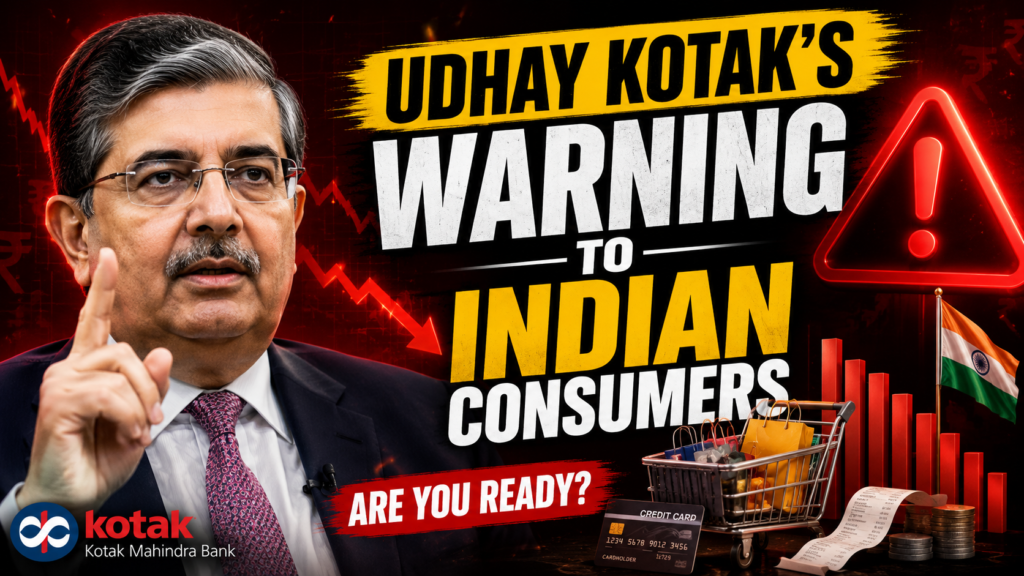
The Emerging Dangers for Indian People
The Impending Fuel Shock: Why Uday Kotak’s Warning Signals an Existential Crisis for the Indian Middle Class
For months, the domestic retail economy has operated inside a deceptively calm bubble. While the skies over West Asia flared up with intense military conflicts, closing critical global maritime chokepoints like the Strait of Hormuz, petrol and diesel pumps across India remained strangely insulated. However, this safety net was never a product of economic immunity—it was a synthetic buffer created by state-owned Oil Marketing Companies (OMCs) quietly burning through older inventories and absorbing catastrophic financial blows onto their own balance sheets.
That insulation is now officially cracking. The recent ₹3 per litre hike in petrol and diesel prices is a stark warning that the corporate shock absorbers have reached their absolute limits. Despite this initial hike, India’s state-backed fuel giants continue to hemorrhage an estimated ₹500 crore every single day. If the full extent of global crude market volatility is passed directly down to the pump, the economic fallout will fundamentally reshape the lifestyle, savings, and survival of the Indian middle class.
The Corporate Shield is Crumbling
India occupies a hyper-vulnerable position in the global energy matrix, relying on foreign imports to satisfy more than 85% of its crude oil requirements. When geopolitical conflicts push global oil benchmarks past $105 to $110 per barrel, the structural machinery of the Indian economy faces intense pressure. Historically, a manageable Current Account Deficit (CAD) relies on crude staying near $60 a barrel. At current levels, the mathematics of national finance turn toxic.
Market experts reveal that even after the latest ₹3 increase, true under-recoveries remain trapped at a staggering ₹13 to ₹15 per litre for petrol and ₹17 to ₹18 per litre for diesel. To return to absolute baseline stability, a retail fuel price hike of nearly 18% would be required. Up until now, OMCs have taken these losses to prevent domestic distress. But with quarterly under-recoveries projected to climb up to ₹2 lakh crore, maintaining this shield indefinitely is a financial impossibility. The dam is bound to burst, and when it does, the downstream rush will directly impact everyday citizens.
The Asymmetric Warfare on Stretched Budgets
To understand why this scenario represents an emerging danger, one must dissect the unique anatomy of middle-class households. Unlike the affluent elite, whose wealth cushions them against price swings, or the lowest economic tiers who occasionally qualify for direct government subsidies, the middle class bears the full force of market corrections with zero structural support.
The impact of a major fuel price hike operates via a destructive dual mechanism:
1. The Direct Squeeze: The immediate, unavoidable expansion of commuting costs. For a middle-class professional relying on a two-wheeler or a modest family car, an increase of ₹15 to ₹20 per litre transforms fuel from an operational utility into a luxury expense. It forces immediate, painful trade-offs, directly shrinking the disposable income available for healthcare, quality schooling, and savings.
2. The Indirect Ripple Effect: Diesel is the literal fuel of Indian commerce. It powers the massive logistics networks, cargo fleets, e-commerce supply lines, agricultural water pumps, and local transport networks that feed the nation. When diesel costs soar, the price of everything traveling on a truck—from seasonal vegetables and milk to clothing and consumer electronics—escalates in tandem.
The Reserve Bank of India and independent economists warn that a full price pass-through would immediately drive retail inflation indices up by 70 to 80 basis points. With food inflation already climbing, a severe energy shock risks pushing headline Consumer Price Index (CPI) numbers well past comfort zones, effectively eating away at the purchasing power of fixed monthly salaries.
From Aspirational Living back to Survivalism
Over the past decade, the definition of the Indian middle class evolved from mere survival to aspirational progress. It was marked by the ability to afford a first car, invest in private tutoring for children, plan an annual domestic vacation, and build a financial nest egg in domestic mutual funds.
A prolonged, unabsorbed energy shock threatens to completely reverse this upward trajectory. When daily essentials absorb a larger portion of the household budget, aspirational spending is the first thing to be cut. Plans to upgrade appliances are canceled; non-essential travel is deferred; and discretionary consumption stalls out entirely. This shift creates a dangerous cyclical drag on the wider economy, directly hitting manufacturing, hospitality, and retail sectors.
Worse still, the pressure heavily damages future financial security. The middle class is the primary driver of India’s domestic investment boom. When monthly household budgets collapse under the weight of inflation, families are forced to scale back or completely pause their Systematic Investment Plans (SIPs) and insurance payments. In a worst-case scenario, households turn to high-interest personal debt simply to bridge the gap between fixed incomes and rising living costs.
Heeding the Warning: A Call for Defensive Discipline
Uday Kotak’s explicit advice—to “prepare for paranoia before the event”—complements recent government guidance urging citizens to moderate unnecessary consumption, conserve fuel, and postpone big-ticket luxury expenses. In an era defined by global fragmentation and intense geopolitical conflicts, the ultimate danger for Indian households lies in remaining in a false comfort zone.
The ₹3 price hike was not an isolated adjustment; it was the opening note of a major macroeconomic shift. As an online community dedicated to tracking the structural vulnerabilities facing our people, we must echo this warning clearly. The corporate buffers are giving way. For the Indian middle class, building personal financial safety nets, eliminating high-cost discretionary spending, and budgeting for severe inflationary shocks are no longer just smart financial options—they are critical strategies for economic survival in an increasingly unstable world.